
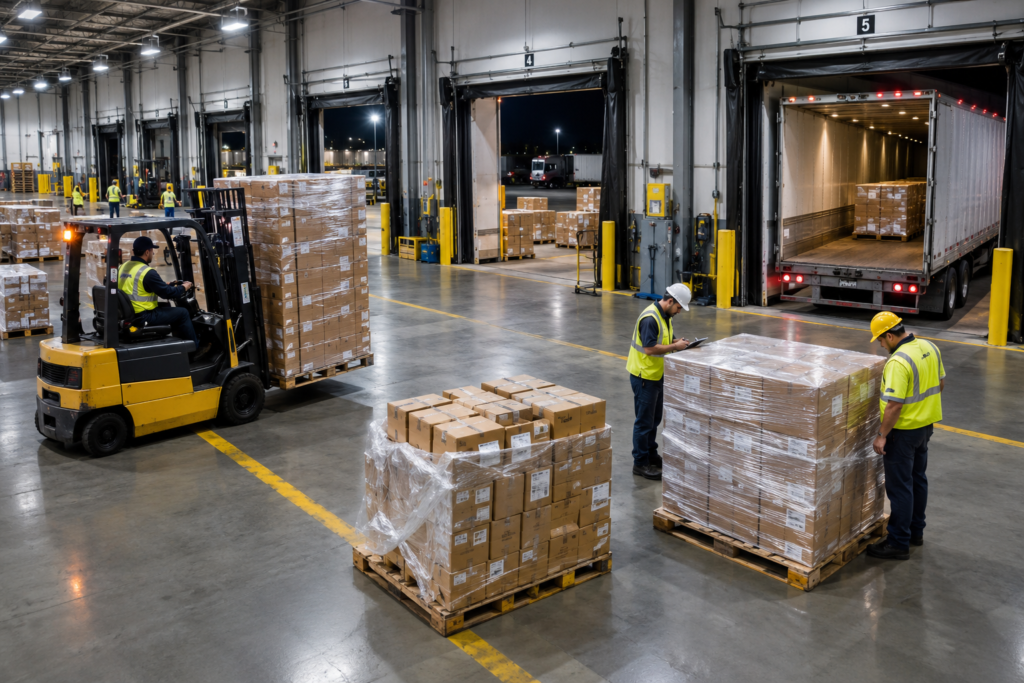
Your driver calls. The distribution center turned them away. The load is sitting in a lot somewhere near Fontana or Ontario, and you’re three hundred miles from the problem at 10pm on a Thursday.
This is one of the most stressful situations in freight — and one of the most common in the Inland Empire. The IE is the busiest inland freight corridor in the western United States, and the DCs here are among the strictest in the country when it comes to compliance. A rejected load here does not mean your load is worthless. It means it needs to be fixed, quickly, and by someone who knows what they’re doing.
This guide walks you through exactly what to do — step by step — so you can recover the load, salvage the appointment, and get the truck back on the road the same shift.
Why DCs in the Inland Empire Reject Loads
Before we get to the recovery steps, it helps to understand what you’re actually dealing with. Distribution centers in the IE — particularly those operated by major retailers and 3PLs in Fontana, Ontario, Rancho Cucamonga, Rialto, and San Bernardino — reject loads for predictable reasons. Most of them are fixable within hours.
The four most common rejection causes:
1. Pallet height out of compliance
Most DCs cap incoming pallets at 48 to 60 inches, depending on the receiver. Loads stacked higher than spec will be turned away at the dock door before they’re even unloaded. This is one of the most common rejection triggers in the IE, particularly on consolidated or mixed loads that got restacked in transit.
2. Shifted or unstable freight
Long hauls into Southern California — especially anything coming in on I-10 from Arizona or I-40 from the east — can cause freight to shift, lean, or partially collapse in transit. A receiver will refuse to accept a leaning pallet because their dock labor won’t touch it, and their insurance won’t cover it. The load gets sent back.
3. Label errors or missing documentation
Wrong placement, missing SSCC pallet labels, labels covered by shrink wrap, or barcodes that don’t scan — any of these will cause an automatic refusal at a DC running automated receiving. This is becoming more common as large-volume DCs upgrade their scanning systems.
4. Damaged or broken pallets
Cracked pallet boards, missing deck boards, or pallets that aren’t structurally sound will be flagged. A pallet that can’t go under a forklift is a liability for the receiving facility. They will not accept it.
Step 1: Don’t Leave the Freight Unattended
The first thing your driver needs to do after a rejection is stay with the load. Do not park the trailer and walk away. Do not leave the freight on the DC lot if the receiver has ordered the truck out.
Your driver should:
- Inspect the freight visually and take photos before anything else
- Immediately re-seal the trailer if it was opened at the dock
- Document the rejection reason the DC gave in writing — get it from the receiver if possible
- Note the exact time, the dock number, and the name of the receiving contact
A clean photo record and a written rejection reason will matter if a cargo claim comes later. A blank POD and a verbal story is how disputes drag out for months.
Step 2: Notify the Broker and Shipper in Writing — Same Day
The moment you know the load is rejected, you need to send written notification to both the broker and the shipper. Not a text. Not a call. A written message you can timestamp — email or a platform message that logs the time.
The notice should state:
- What was rejected
- The reason given by the DC
- Where the freight is currently located
- That you are requesting disposition instructions
Under freight law, your carrier has a possessory lien on rejected freight. You are not required to return the load to origin without compensation, and you are not required to abandon it. But you are required to make reasonable efforts to protect the freight while disposition is worked out.
Notifying all parties in writing protects you. It establishes the timeline and removes the “we didn’t know” defense from anyone downstream.
Step 3: Identify the Fix — and Get to a Rework Facility Fast
For most IE rejections, the fastest resolution is not to wait for a new appointment or renegotiate with the DC. It’s to take the load to a freight rework facility, fix the problem, and reattempt the delivery the same day.
Here is what each common rejection type requires:
| Rejection Reason | Rework Needed | Typical Time |
| Pallet height out of spec | Restack to compliant height, re-wrap | 1–2 hours |
| Shifted or leaning freight | Restack, re-band, re-shrink wrap | 1–2 hours |
| Broken or cracked pallets | Transfer to new pallets, repalletize | 1–3 hours |
| Label errors | Re-label, verify barcodes, re-wrap | 45 min–2 hours |
| Overweight axle | Redistribute cargo across trailer | 2–3 hours |
A properly equipped rework facility will handle all of these. What you need is a dock that:
- Is open right now (not tomorrow morning)
- Has forklifts and pallet jacks on-site
- Has new pallets, shrink wrap, bands, and labels stocked
- Can turn your load in a few hours, not a few days
- Provides documentation you can show the DC on reattempt
In the Inland Empire, there are very few 24/7 options for this. Most crossdock facilities only take scheduled appointments. Some are closed on weekends. If your rejection happened at night or on a weekend — which in the IE it frequently does, given how many DCs run extended receiving hours — your options narrow fast.
Step 4: Stage for Reattempt — Don’t Lose the Appointment Window
Once the load is reworked, you have two objectives: document the correction and get the DC back on the phone.
Documentation for the reattempt:
- Photos of the reworked pallets (before and after, if possible)
- New pallet count and weight verification
- New labels if relabeling was required
- A brief written summary of what was corrected and by whom
Bring this to the DC on reattempt. Most receivers who turned a load away for pallet condition or compliance will accept it on the same day if the issue is clearly corrected and documented. The key is to get this done inside their current receiving window rather than waiting for a new appointment.
If the receiving window has closed for that day, this is where short-term freight staging becomes valuable. A rework facility that also offers per-pallet overnight staging can hold your load — correctly fixed, documented, and ready to move — until the DC opens tomorrow morning. This keeps the freight off the truck, off the street, and in a position to make the next available window.
Step 5: Know Your Cost Recovery Options
A rejected load costs everyone money. The question is who absorbs how much.
If the rejection was caused by carrier handling (shift in transit): The carrier is typically responsible for the rework cost and potentially the redelivery appointment fee. Document everything before admitting fault — some rejections get blamed on the carrier that belong to the shipper’s packing operation.
If the rejection was caused by shipper packing errors (wrong labels, non-compliant pallet configuration): The shipper bears responsibility. Your written notification from Step 2 establishes the timeline. The rework cost should come out of the shipper’s settlement, not the carrier’s rate.
If the cause is unclear: Minimize the loss first, argue responsibility second. A load sitting in a lot is losing value. A load that gets fixed and delivered is a loss mitigated. Document the correction and recover the freight — then have the conversation about who pays.
Always get itemized documentation from your rework facility: what was done, how long it took, what materials were used. This is what goes into a claim.
What Happens If You Can’t Find a 24/7 Rework Facility in the IE
This is the real problem most carriers and brokers run into. The Inland Empire has hundreds of warehouse and dock facilities, but finding one that is:
- Actually open at 11pm or on a Sunday
- Staffed and equipped, not just “technically open”
- Able to handle the job same-shift without a 48-hour lead time
…is harder than it should be.
The facilities that exist for this work in the IE are:
- Large 3PL operations that prioritize their own account customers
- Small rework shops that run limited hours
- Crossdock facilities that do rework as a secondary service
Crossdocks Pro at 10681 Production Ave, Dock 107 in Fontana is one of the only facilities in the corridor built specifically to handle this. Walk-ins are accepted 24 hours a day, seven days a week — including weekends and holidays. The dock is minutes from both I-10 and I-15. Forklifts, pallet jacks, shrink wrap, bands, and new pallets are on-site. No appointment needed.
If your driver has a rejected load anywhere in Fontana, Ontario, Rancho Cucamonga, Rialto, or San Bernardino right now: call (909) 302-1810. The dock team answers directly — no voicemail, no automated system. Average rework turnaround is under two hours for standard jobs.
Frequently Asked Questions
The Short Version
If your load just got rejected at a DC in the Inland Empire:
- Driver stays with the freight and takes photos
- Notify broker and shipper in writing, same day
- Identify the rejection reason and get to a rework facility
- Fix the load, document the correction
- Reattempt delivery or stage overnight for the next window
The facility that handles this at any hour: Crossdocks Pro, 10681 Production Ave Dock 107, Fontana CA. Open 24/7. Walk-ins welcome. (909) 302-1810.
About Crossdocks Pro
Crossdocks Pro operates a 24/7 crossdock and freight rework facility in Fontana, CA — minutes from I-10 and I-15 in the heart of the Inland Empire freight corridor. We handle rejected loads, shifted pallets, load rework, pallet restacking, LTL consolidation, and emergency freight recovery same-shift. 49+ five-star Google reviews. No appointment needed.
Address: 10681 Production Ave, Dock 107 · Fontana, CA 92337
Phone: (909) 302-1810
Operate: Open 24 hours, 7 days a week