Running freight through the Inland Empire? Here’s how to find a crossdock facility that won’t cost you a shift — or your HOS window.
If you’re hauling lanes through Southern California, the I-10 and I-15 corridor isn’t optional — it’s the pipe everything moves through. The Inland Empire sits at that intersection, and it’s one of the busiest freight corridors in the entire United States. Amazon, FedEx, XPO, every major retailer’s DC operation — they all route through here.
That means when you need a cross-docking facility in this region, you need one that can keep pace. The wrong dock wastes hours. The right one gets you back on the road in under an hour.
This guide breaks down what to actually look for when sourcing a crossdock partner near I-10 and I-15 in Southern California — the criteria that matter in the real world, not on a sales sheet.
Why the I-10/I-15 Interchange Is the Crossdocking Hub of the West Coast
Before getting into the selection criteria, it’s worth understanding why this corridor dominates.
The Ports of Los Angeles and Long Beach together handle roughly 40% of all container imports entering the United States. Every container that doesn’t get railed inland has to move by truck — most of it east on I-10 or north on I-15. That makes Fontana, Ontario, Rialto, and Rancho Cucamonga the natural staging ground for the entire West Coast distribution chain.
If your freight is coming off a rail ramp, exiting the Port, or running a SoCal-to-Southwest lane, you’re already touching this corridor. A crossdock facility positioned minutes from both interstates doesn’t just save miles — it saves hours of deadhead and detention that destroy a driver’s day and a shipper’s delivery window.
Maersk chose Fontana for exactly this reason when they expanded their ground freight network in 2026. So did every major 3PL and fulfillment operator in the region. The dock capacity here exists because the freight volume demands it.
6 Things That Actually Matter When Choosing a Crossdock Facility in SoCal
1. Location Relative to the Interstate — Measure in Minutes, Not Miles
The single most important factor is how many minutes off the interstate the facility sits. Not miles. Minutes.
A facility three miles off I-10 with poor truck access and poor signal can eat 20–30 minutes of a driver’s HOS clock before a single pallet is touched. A facility one mile off with a direct truck route and a clear check-in process costs almost nothing.
When you’re evaluating a crossdock facility near I-10 and I-15, ask:
- Which exit from which interstate?
- How many turns from the off-ramp to the dock?
- Is the access route truck-friendly (no low bridges, no tight residential streets)?
- Is there room to stage while waiting for a dock door?
Fontana’s freight corridor on Production Ave is a direct example of this done right. Facilities along this stretch sit between I-10 (immediately south) and I-15 (immediately east), with wide industrial streets, paved truck aprons, and no complex navigation for drivers unfamiliar with the area.
2. Operating Hours — 24/7 Is Not a Marketing Line, It’s Operational Reality
The Inland Empire freight market does not run 9-to-5. Import containers release overnight. Emergency loads get rejected at 11pm. Drivers running HOS windows often hit a facility at 2am to maximize the next day’s delivery window.
A crossdock facility that closes at 6pm or requires 48-hour advance notice is not actually solving your problem — it’s adding a constraint on top of it.
What to verify:
- Are the dock doors physically open, or just “available by appointment”?
- Is there a live person answering the phone at 2am, or does it go to voicemail?
- Can a driver walk in off the interstate without a pre-booked slot?
Walk-in capability matters. If a load shifts on the I-10 and a driver needs to restack at 3am to make a morning delivery window, they need to be able to pull into a dock — not schedule something for tomorrow.
3. Dock Count and Throughput Capacity
One of the fastest ways to get burned on a crossdock relationship is picking a facility with four dock doors and a 3-hour wait because another carrier’s load is blocking the bay.
For high-volume corridors like the Inland Empire, you want a facility with enough doors that your driver isn’t competing for dock position. As a rough benchmark:
- Under 8 doors: fine for low-volume, pre-scheduled work only
- 8–20 doors: adequate for most LTL and occasional FTL needs
- 20+ doors: can handle live drops, emergency freight, and simultaneous multiple loads without a queue
Crossdock facilities in the Fontana-Ontario-Rancho Cucamonga belt tend to be larger because the freight volume demands it. If the facility you’re evaluating can’t tell you how many dock doors they have, that’s a red flag.
Also ask: do they separate inbound and outbound dock lanes? A facility where inbound and outbound traffic share the same apron creates congestion that slows your turnaround even when they have capacity.
4. Services Under One Roof — Can They Fix What the Road Broke?
Cross-docking is the core service. But freight doesn’t always arrive in crossdock-ready condition. Pallets shift in transit. Loads get rejected at DCs for height or condition violations. Weight gets distributed wrong and a driver gets flagged at the scale.
A crossdock facility that can only transfer clean, ready freight is useful. One that can also correct the freight — restack it, re-band it, redistribute weight, re-label, re-palletize — is indispensable.
Look for a facility that offers at minimum:
- Pallet restacking and rework
- Shrink wrap and re-banding
- LTL consolidation (combining partials into full outbound trailers)
- Short-term pallet staging when a delivery window slips
- Reverse logistics and return staging
If you have to call three different vendors to handle a single distressed load, you’re losing time and coordination. The facility that handles all of it in-house on one dock call is where you build a long-term relationship.
Our cross-docking services in Fontana include same-shift dock-to-dock transfers, LTL consolidation, and transloading. Our freight restacking and load rework runs 24/7 and handles everything from shifted pallets to DC-rejected loads on the same shift.
Pricing Structure — Know What You’re Paying Before the Trailer Backs In
Crossdock pricing in Southern California can be quoted several ways. None is inherently better — what matters is that the quote you get upfront is the invoice you receive after.
The main pricing models:
Per pallet: Charged per pallet handled inbound or outbound. Best for LTL loads, partial trailers, and situations where load size varies run to run.
Per trailer: Flat rate per inbound trailer regardless of pallet count. Best for standard FTL crossdock transfers where load size is consistent.
Contract / volume rate: Monthly or seasonal rate for carriers and 3PLs running regular lanes. Usually comes with reserved dock windows and a dedicated contact.
What to avoid:
- Facilities that add storage fees after the fact for “overnight staging” on a same-day crossdock job
- Hidden fees for forklift time, shrink wrap, or documentation that weren’t in the original quote
- Minimum contract requirements for one-off emergency loads
Ask the question directly: “If I need to make one emergency load rework on a Saturday night, what’s the flat cost, all in?” A facility confident in their pricing will answer that immediately. One that hedges or routes you to a pricing sheet probably has add-ons.
Reviews and Reliability — What Actual Carriers and Brokers Say
Crossdock reliability is impossible to verify from a website. What you can verify is what people who’ve actually used the facility say about it — specifically carriers, owner-operators, freight brokers, and 3PL operations managers, not general business reviews.
When you’re reading Google reviews on a potential crossdock facility, filter for:
- Reviews mentioning specific scenarios (rejected loads, late-night arrivals, emergency rework)
- Reviews from verified carrier or broker accounts, not anonymous
- Response pattern from the facility — do they actually respond to reviews, and do the responses sound operational?
A 5-star average across 10 reviews from unverifiable accounts doesn’t mean much. Fifty verified reviews from carriers mentioning the same driver’s name, consistent turnaround times, and after-hours responsiveness — that tells you something real about how the operation runs.
The Inland Empire Crossdock Option Built for the I-10/I-15 Corridor
If your lanes run through Fontana, Ontario, Rancho Cucamonga, Rialto, San Bernardino, or anywhere in the Inland Empire belt, Crossdocks Pro is positioned to be your go-to dock stop.
Here’s what that means in practice:
- Location: 10681 Production Ave, Dock 107, Fontana, CA 92337 — minutes from I-10 (south) and I-15 (east), with direct truck access and no difficult navigation
- Hours: Open 24 hours a day, 7 days a week, 365 days a year — including weekends, holidays, and overnight
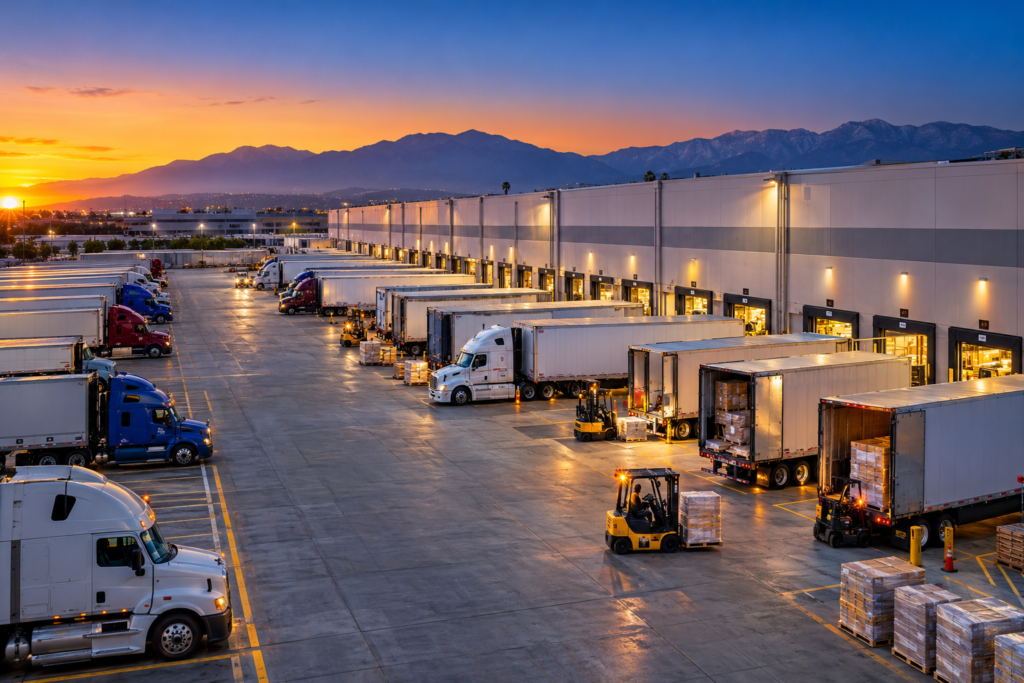
- Dock capacity: 24 dock doors on site, 150,000 sq ft of yard and dock space — no long waits, no queuing behind other loads
- Services: Crossdocking and transloading, freight restacking, pallet rework, LTL consolidation, FTL trailer swaps, short-term overflow staging, reverse logistics — all under one roof
- Pricing: Per-pallet, per-trailer, and contract volume options — quoted before the trailer backs in, no surprise add-ons
- Reviews: 5.0 rating on Google with 49+ verified reviews from carriers, brokers, and operations managers
Walk-ins are welcome at any hour. No appointment required — pull in, check in at Dock 107, and we get your freight moving. Average dock-to-dock time: under one hour on standard loads.
See our full list of services or see our location and get directions.
Frequently Asked Questions
Ready to Book a Dock Door?
Whether you’re running a scheduled lane or dealing with a freight emergency right now, our dock team is on-site and ready.
Call (909) 302-1810 — available 24/7, no automated system, real people at the dock.
Or get a dock quote online and we’ll respond within the hour.
📍 10681 Production Ave, Dock 107 · Fontana, CA 92337 · Open 24/7 · Walk-Ins Welcome